Magic Elephant Trunk

Arvind Singh
| 01-04-2026
 · Animal Team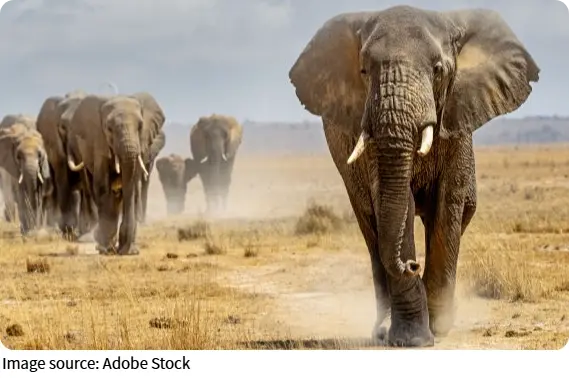
We all know elephants as the giants of the land, but their long trunks aren’t just a funny feature—they’re essential tools for survival. Along with tusks, the trunk is one of their most iconic traits.
While tusks are basically enlarged upper teeth that grow continuously, the trunk is where the real magic happens.
Let’s explore six amazing ways elephants use their trunks in daily life.
Breathing Made Easy
We often think a trunk is just a long nose, but it’s much more than that. The tip has two large nostrils, which serve as the main airways. The trunk’s length allows elephants to filter dust and dirt from the air thanks to the moisture inside. This keeps the air they breathe extra clean.
Elephants also love water. With nearly hairless skin, tropical heat can dry them out or attract parasites. So a swim is both cooling and protective. When crossing rivers, the trunk is essential. A full-grown elephant stands around 3 meters tall, and with a trunk about 1.5 meters long, it can breathe safely even in water as deep as 4.5 meters. No splashing, no struggle—just effortless survival.
Staying Hydrated
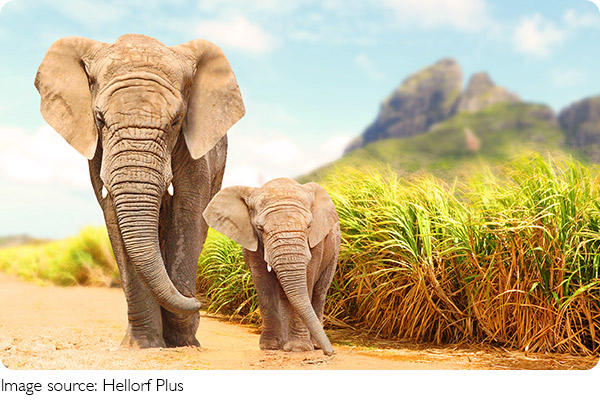
Water is vital for these large tropical animals, but bending down to drink isn’t easy with such a massive body and a short neck. That’s where the trunk comes in. Elephants draw water into their trunks and then pour it into their mouths.
The trunk also doubles as a sprinkler. In shallow water or on hot days, elephants can draw water into their trunks and spray it over their bodies. This cools them down and keeps their skin moist. Thanks to a clever piece of cartilage at the trunk’s tip, water is stored safely inside while drinking, preventing any choking.
Feeding Flexibility
Imagine trying to eat grass while kneeling every few steps—that would be exhausting for a giant like an elephant. Instead, the trunk acts as a handy conveyor belt. It curls up grass from the ground and delivers it directly to the mouth.
High-hanging fruits are no problem either. Asian elephants in rainforests, for example, can reach fruits up to 4 meters above the ground thanks to their height and trunk length. This allows them to enjoy tropical fruits without breaking a sweat.
Tracking Friends and Food
Elephants have an extraordinary sense of smell, thanks to millions of olfactory cells in their trunks. This allows them to detect scents left by other elephants, such as footprints or droppings, helping them navigate.
They can even tell age, gender, and individual identity through scent alone. Research shows elephants can recognize their companions and even differentiate between humans just by smell. The trunk is basically their GPS and detective rolled into one.
Communication Power
Though elephants are enormous, a regular vocal call from the throat is low and soft—enough for close friends but not for distant ones. That’s where the trunk amplifies sound. The trunk turns soft calls into loud, piercing trumpets, perfect for group communication.
Elephants also use infrasound—sounds too low for humans to hear. These are produced by multiple body parts working together, from throat vibrations to trunk and skull resonance, allowing elephants to communicate over miles silently to us.
The Ultimate Tool and Defender
The trunk is made of around 40,000 muscles, making it incredibly flexible and strong. Walking through tall grass, elephants can detect and move hazards like snakes or obstacles.
It’s also a practical tool for protection. Female elephants without visible tusks can swing their trunks to fend off threats. They can even lift or move heavy trees blocking their path, showing just how versatile this “arm” truly is. The trunk combines defense, offense, and practical everyday use, making it more crucial than tusks for survival.
Why the Trunk Wins
Looking at all these abilities—breathing, drinking, eating, tracking, communicating, defending, and moving obstacles—the trunk is clearly the elephant’s most essential feature. While tusks are important, the trunk is truly a multi-functional tool that starts working from birth and continues to support the elephant throughout life. Without it, life as an elephant would be nearly impossible.
Lykkers, next time you see an elephant, take a moment to admire that amazing trunk—it’s far more than just a funny long nose. It’s a marvel of evolution, a lifeline, and the ultimate multi-tool of the animal kingdom.
The Elephant Trunk | How does it work?
Video by Mind Brunch