You Are Made of Starlight

Finnegan Flynn
| 25-04-2026
 · Science Team
Look at that spiral. That glowing, spinning, impossibly beautiful pinwheel of light stretching across the darkness. What you're seeing isn't just a pretty picture — it's roughly 200 to 400 billion stars, all orbiting a common center, many of them surrounded by their own planets, some of those planets almost certainly harboring conditions that could support life.
And here's the part that should genuinely stop you mid-scroll: our own Sun, our Earth, and every single atom in your body came from a system that looks exactly like this one. We didn't just come from nature. We came from a galaxy.
What Is a Spiral Galaxy, Actually
A spiral galaxy is a rotating disk of stars, gas, and dust with a bright central bulge and distinctive curved arms sweeping outward like a cosmic pinwheel. The Milky Way — our home — is one, and so is Andromeda, our nearest large galactic neighbor. The spiral arms aren't fixed structures spinning like a solid object. They're actually density waves, similar to a traffic jam on a highway — the cars (stars) keep moving through, but the jam (the arm) stays in roughly the same place. Stars take hundreds of millions of years to complete a single orbit around the galactic center. Our Sun has only made about 20 full trips since it formed 4.6 billion years ago.
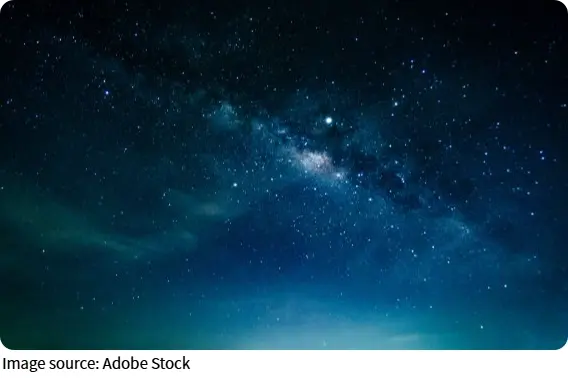
That Glowing Core Isn't Just Pretty
See that blazing white-pink center? Most spiral galaxies, including the Milky Way, harbor a supermassive black hole at their core. Ours is called Sagittarius A*, and it has a mass equivalent to about 4 million suns compressed into a region smaller than our solar system. The bright glow you see around the center isn't the black hole itself — black holes don't emit light — but the superheated material spiraling into it, reaching temperatures of millions of degrees and radiating energy across the entire electromagnetic spectrum. In more active galaxies, this central engine becomes so powerful it outshines everything else combined. Astronomers call these quasars, and some are so luminous they can be detected from across the observable universe.
Where Stars Are Actually Born
Those wispy blue-teal clouds trailing along the spiral arms aren't decoration. They're stellar nurseries — vast clouds of hydrogen gas and dust called nebulae, where gravity slowly pulls material together until pressure and temperature become high enough to ignite nuclear fusion. A single large nebula can give birth to thousands of stars simultaneously, each potentially developing its own planetary system over the next few million years. The Orion Nebula, visible to the eye from Earth on a clear night as a fuzzy patch in Orion's belt, is doing exactly this right now — roughly 700 new stars are currently forming inside it, some already surrounded by protoplanetary disks.
The Scale Will Rearrange Your Brain
Here's a number worth sitting with: the galaxy in this image is probably somewhere between 50,000 and 100,000 light-years across. One light-year is about 9.46 trillion kilometers. The fastest spacecraft humanity has ever launched — Voyager 1, moving at roughly 61,000 km/h — would take over 17,000 years to travel just one light-year. To cross a galaxy like this one at that speed would take somewhere in the neighborhood of 1.7 billion years. And this galaxy is just one of an estimated two trillion galaxies in the observable universe. The observable universe. Meaning the part we can actually see from Earth, limited by the speed of light and the age of the cosmos.
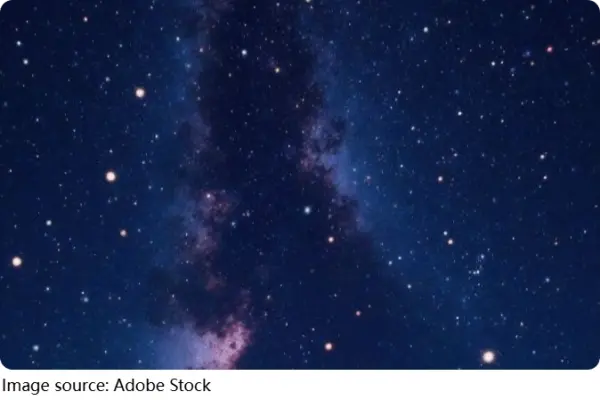
Why Any of This Matters to You
Every carbon atom in your body was synthesized in the core of a massive star that lived and died before our Sun even existed. Every iron atom in your blood was forged in a stellar explosion powerful enough to briefly outshine an entire galaxy. The calcium in your bones, the oxygen in your lungs, the phosphorus in your DNA — all of it was produced in stellar interiors and scattered across space when those stars reached the end of their lives. Astronomer Carl Sagan said it plainly decades ago, and it remains the most accurate thing ever said about human identity: we are star stuff. This image isn't just astronomy. It's a family portrait.